


Statuario porcelain tiles offer the refined look of white marble without many of the maintenance concerns linked to natural stone. Their white marble effect surface and bold grey veining can suit homes, hotels, shops, and offices.
However, appearance is only one part of the decision. Tile size and thickness affect grout lines, weight, cutting, installation, application, and total project cost. Available specifications also vary between manufacturers and collections.
This Statuario tile size and thickness guide explains common formats, practical applications, technical details, and supplier checks. Always confirm the final specification on the current product data sheet before placing an order.
What Sizes Do Statuario Tiles Come In?
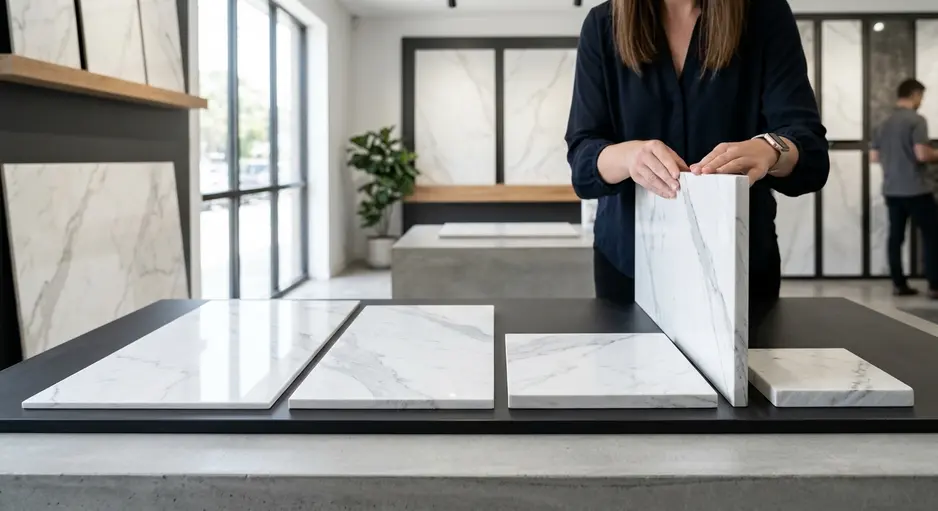
Statuario tile dimensions cover standard squares, large rectangles, and oversized porcelain slabs. The following sizes are representative examples. They may not be available from every supplier.
Common Statuario Tile Dimensions
Standard square tiles
Formats such as 600 × 600 mm and 800 × 800 mm are practical for bedrooms, kitchens, apartments, and medium-sized commercial rooms. They are generally easier to carry and cut than oversized panels.
Large rectangular tiles
Sizes such as 600 × 1200 mm and 800 × 1600 mm work well on living room floors, feature walls, and reception areas. Their long shape can help direct the eye along a main sightline.
Large square tiles
Formats such as 1000 × 1000 mm and 1200 × 1200 mm create fewer joints in open-plan spaces. They require careful planning because uneven floors can make lippage more visible.
Porcelain slabs
Representative Statuario slab sizes include 1200 × 2400 mm and 1600 × 3200 mm. These panels may be used for feature walls, furniture surfaces, counters, and luxury interiors when approved for the application.
Nominal Size vs Actual Working Size
An advertised size may be nominal rather than the exact measured dimension. Buyers should confirm the actual calibre, permitted tolerances, thickness tolerance, and rectified edge precision.
Rectified edges support controlled grout joints, but they do not make grout unnecessary. Check the supplier’s grout joint width recommendations and the installation standard used in your region.
How Size Affects Vein Continuity
Broad Calacatta-style veining patterns often look more continuous on larger panels. Before approval, review full-face images and several physical samples. Ask about graphic faces, vein variation, and book-matching options instead of judging the design from one small piece.
How to Choose the Best Statuario Tile Size
Best Size for Living Room Floors
The best Statuario tile size for living room floors is often 600 × 1200 mm, 800 × 1600 mm, or 1200 × 1200 mm. The choice depends on room proportions, floor flatness, access, and the position of doors and fixed furniture.
Fewer grout joints can make an open room feel larger. In a long rectangular space, laying elongated tiles along the main sightline may improve visual flow. A room with columns or several corners may suit a moderate format because it can reduce difficult cuts and waste.
Bathroom Walls and Floors
Statuario tiles for bathroom walls and floors may require different formats. Large panels can create a clean feature wall, while moderate floor tiles are easier to shape around drains, sanitary fittings, niches, and shower falls.
A polished porcelain finish can give walls a bright, reflective appearance. For floors, check the declared slip test result and wet-area suitability. A matte porcelain finish is not automatically slip-resistant, so do not select it by appearance alone.
Large Formats for Luxury Interiors
Large format Statuario tiles for luxury interiors can suit villas, hotel lobbies, retail spaces, and reception areas. They provide fewer visible joints and allow the marble-inspired design to flow across a wider surface.
The trade-offs include higher handling costs, stricter substrate requirements, specialist cutting, and greater breakage risk. Oversized slabs also need trained installers, suitable access, and the right lifting equipment.
Prepare a Layout Before Ordering
- Map doors, columns, drains, counters, and focal walls.
- Avoid narrow tile strips around the room perimeter.
- Plan vein direction across highly visible surfaces.
- Allow waste for cuts, damage, matching, and future repairs.
- Ask the installer to approve the layout and panel size.
Statuario Tile Thickness Options Explained
Thickness should never be selected in isolation. Panel dimensions, porcelain body composition, substrate support, edge details, and intended use all affect performance.
Typical Porcelain Thickness Ranges
Approximately 6 mm
Thin panels may be used for wall cladding, renovation systems, furniture, and other specialist applications. They require approved adhesives, handling methods, and support.
Approximately 8–9 mm
This range is common for residential walls and floors when the product is approved for those uses. Correct substrate preparation and adhesive coverage remain essential.
Approximately 10–12 mm
These Statuario tile thickness options may be offered for large floors, demanding interiors, and selected fabricated surfaces. The extra weight must be considered during transport and installation.
Approximately 15–20 mm
Thicker products may be available for worktops, counters, furniture, or specialist systems. Availability and permitted applications depend on the collection.
9 mm vs 12 mm Statuario Porcelain Tiles
In a 9 mm vs 12 mm Statuario porcelain tile comparison, the 9 mm product is lighter and may be easier to transport and handle. Properly manufactured 9 mm porcelain can be suitable for many wall and floor installations.
A 12 mm panel is thicker and heavier. It may be preferred for certain large-format or fabricated uses, but it is not automatically stronger or better. Compare bending strength specifications, slab weight per square metre, panel dimensions, support needs, and declared application.
Thickness also affects cutting equipment, carrying risk, freight, and labour. Overall performance depends on manufacturing quality and installation—not thickness alone.
Thickness for Kitchen Countertops
Statuario tile thickness for kitchen countertops may be 12 mm in some approved slab systems. Other projects use thicker slabs or built-up edges to create a deeper visual profile.
A fabricator must assess cabinet support, sink and hob cut-outs, overhangs, joints, edge profiles, heat, and impact exposure. Use a product approved for countertop fabrication and follow the manufacturer’s instructions and local building rules.
Look Beyond Size and Thickness
Water Absorption and Classification
Porcelain is generally associated with very low water absorption. Under standards such as ISO 13006, EN 14411, and ANSI A137.1, technical classification is based on tested properties rather than the visual design name.
Request a current test report for water absorption performance, especially for kitchens, bathrooms, and humid areas. “Statuario” describes the marble-inspired design. It does not define the body, strength, finish, or installation suitability.
Strength and Abrasion Resistance
Bending or breaking strength shows how a tile performs under an applied load during testing. Review it together with thickness, panel size, support conditions, and installation method.
Surface abrasion resistance matters for busy floors. A feature wall and a commercial entrance do not face the same wear. Ask whether the declared rating suits expected foot traffic and cleaning routines.
Substrate Compatibility
Concrete, screed, backer board, existing tile, and timber-based assemblies need different preparation. Moisture, curing, movement, deflection, and flatness must be checked before work starts.
The TCNA Handbook and relevant local standards provide guidance on substrate preparation, movement joints, and installation systems. The adhesive supplier should also confirm compatibility with the tile and base.
Installing Large Statuario Tiles Correctly
Flatness and Lippage Control
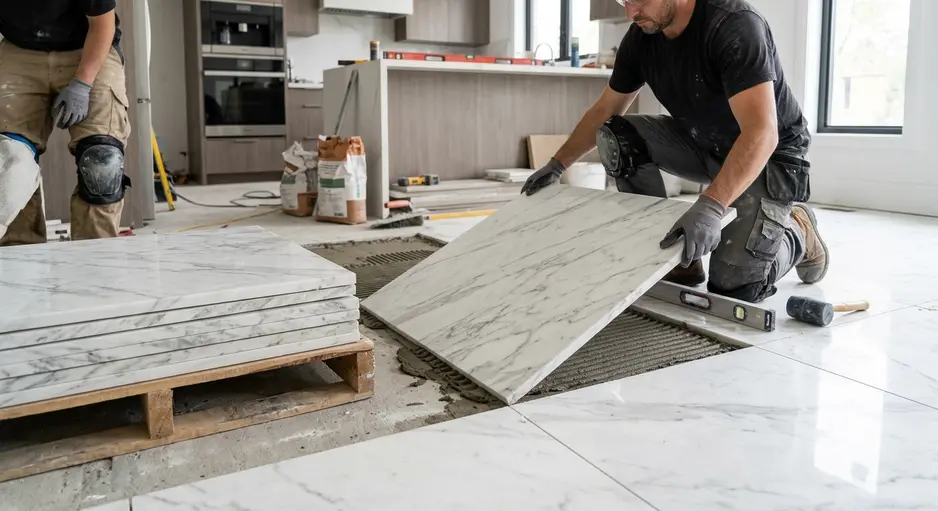
Large tiles need a properly prepared base. The installer should correct high and low areas before laying begins, select the right trowel, achieve the required adhesive coverage, and back-butter tiles where needed.
Lippage-control clips can help keep neighbouring edges aligned. They cannot flatten an uneven floor or replace correct adhesive application.
Grout and Movement Joints
Rectified tiles should not be installed groutless. Joint width must account for dimensional variation, room geometry, thermal movement, the relevant installation standard, and manufacturer guidance.
Grout joints sit between tiles. Perimeter and movement joints serve a different purpose by allowing the assembly to accommodate movement. They should not be filled with rigid grout when a flexible joint is required.
Cutting, Finishing, and Handling
Tile cutting and edge finishing may involve wet saws, rail cutters, drills, or waterjet equipment. Mitred edges and openings near slab corners demand careful planning. Trial cuts can help confirm tool settings before fabrication.
Installation handling requirements may include carrying frames, suction cups, rigid supports, storage racks, and team lifting. Confirm slab weight per square metre and check stairs, lifts, corridors, and door openings before delivery.
What Affects Statuario Tile Price?
Statuario tile price varies with format, thickness, finish, edge treatment, graphic variation, and performance classification. Large slabs usually involve more demanding packaging, freight, insurance, handling, and fabrication than standard tiles.
Vein-matching features, rectified edges, polished surfaces, and a greater number of graphic faces may also affect cost. Compare current quotations for the exact batch and specification rather than relying on a general price per square metre.
Compare the Installed Cost
- Substrate levelling and preparation
- Specialist adhesive and grout
- Handling and lifting equipment
- Professional cutting and drilling
- Additional labour and wastage
- Delivery, storage, and breakage risk
A large slab may cost more to buy and install, yet provide better visual continuity. A smaller format may lower cutting difficulty and waste in compact or irregular rooms.
How to Evaluate a Statuario Tile Supplier
Request Technical Documents
A reliable Statuario tile supplier should provide enough information for technical and commercial evaluation. Before ordering, request:
- Exact dimensions and thickness tolerances
- Water absorption test results
- Bending or breaking strength data
- Surface abrasion and slip data where relevant
- Weight per tile, slab, and square metre
- Recommended adhesive and installation method
- Packing, pallet, and loading details
Confirm Shade and Batch Details
Batch-to-batch shade consistency should be checked before a large purchase. Confirm shade, calibre, finish, batch codes, and the number of graphic faces. Review several current-batch tiles together under lighting similar to the project site.
Do not assume that later replacement stock will match the first delivery. Keeping a reasonable quantity from the original batch can make future repairs easier.
Bulk Orders for Commercial Buyers
When sourcing Statuario tiles in bulk for dealers and distributors, ask about minimum quantities, lead times, container loading, pallet protection, export documents, replacement terms, and destination-specific compliance. Confirm private labelling or OEM services only if the supplier currently offers them.
Request Details from Liberta Vitrified
Buyers can review the available Statuario porcelain tile options through Liberta Vitrified. Request the current catalogue, technical data sheet, samples, quotation, and packing details directly from the company before making a specification decision.
Share your application, preferred format, required thickness, finish, quantity, and destination to receive a more accurate recommendation and quotation.
Choose the Specification, Not Just the Look
The right Statuario format balances design goals with safe handling and reliable installation. Large panels offer fewer joints and stronger vein continuity, while moderate sizes can simplify cutting and reduce waste.
Before buying, confirm actual dimensions, thickness, weight, finish, test results, batch details, and application approval. A clear layout and complete technical data will help homeowners, designers, builders, and distributors avoid costly surprises while achieving a refined marble-look result.
Frequently Asked Questions
1. What is the most popular Statuario tile size?
600 × 1200 mm is widely used because it balances visual impact with practical handling. However, the best format depends on room proportions, substrate condition, cutting needs, and supplier availability.
2. Is 9 mm Statuario porcelain strong enough for floors?
A properly manufactured 9 mm tile may be suitable for residential or commercial floors when it is approved for that use and installed over a compliant substrate. Check its test data and installation instructions.
3. Is 12 mm porcelain better than 9 mm?
Not in every case. A 12 mm tile is thicker and heavier, but suitability also depends on bending strength, panel size, support, body quality, and installation. Select the specification for the application.
4. What size works best in a small bathroom?
Moderate floor formats are often easier around drains, corners, and shower slopes. Larger panels can work well on clear wall areas. A scaled layout will show which option creates balanced cuts.
5. Can Statuario porcelain be used on countertops?
Yes, if the specific slab is approved for countertop fabrication. Proper cabinet support, cut-out detailing, edge finishing, joint planning, and professional fabrication are essential. Explore further